

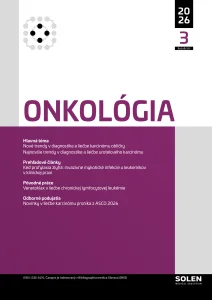


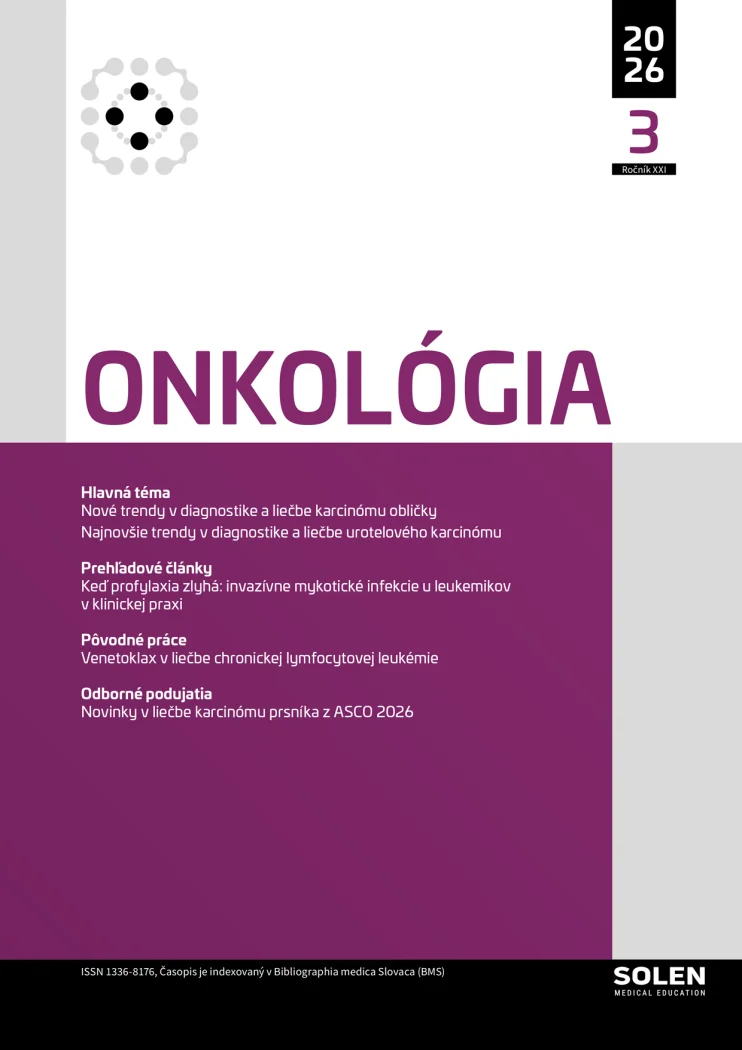
Onkológia 3/2026
Venetoklax v liečbe chronickej lymfocytovej leukémie
MUDr. Juliana Holasová, MUDr. Alexander Wild, PhD.
Úvod: Liečba pacientov s chronickou lymfocytovou leukémiou (CLL) prešla v posledných rokoch významnými zmenami.Štandardná chemoimunoterapia sa zmenila na cielenú inhibíciu modernými liekmi, ktoré majú podľa registračných klinických štúdií lepšiu účinnosť a významne zlepšujú celkové prežívanie pacientov.
Súbor pacientov a metódy: V retrospektívnej analýze sme vyhodnotili 47 pacientov s CLL, ktorí podstúpili liečbu venetoklaxom na Hematologickom oddelení Fakultnej nemocnice s poliklinikou F. D. Roosevelta v Banskej Bystrici na Slovensku (FNsP FDR BB) v rokoch 2019 – 2025. Cieľom tejto práce bolo retrospektívne zhodnotiť účinnosť a bezpečnosť venetoklaxu pri liečbe pacientov s CLL. Medián veku pacientov v čase začatia liečby venetoklaxom bol 69 rokov, v rozmedzí 48 – 84 rokov. Väčšina pacientov, 30 (65 %) boli muži a 17 (35 %) ženy. Pacienti boli liečení venetoklaxom v prvej a vyššej línii v kombinácii s obinutuzumabom, s rituximabom a v monoterapii. Z nich bolo 18 (38 %) pacientov po predchádzajúcej liečbe ibrutinibom. Indikácie liečby a hodnotenie odpovede boli založené na medzinárodnom workshope o kritériách chronickej lymfocytovej leukémie (iwCLL) z roku 2018. Pacienti boli hodnotení najmenej po dvoch mesiacoch liečby až do progresie ochorenia. Účinok liečby bol hodnotený objektívnym vyšetrením pacienta, prípadne zobrazovacím vyšetrením (ultrasonografia – USG, počítačová tomografia – CT) a vyhodnotením parametrov krvného obrazu. Nežiaduce účinky boli hodnotené na základe Common Terminology Criteria for Adverse Events (CTCAE) verzie 5.0. V prípade progresie ochorenia bola liečba prerušená.
Výsledky: Výsledky našej práce potvrdili účinnosť a bezpečnosť venetoklaxu v kombinácii s obinutuzumabom, rituximabom, a to aj v monoterapii u pacientov s CLL. Účinnosť uvedených režimov v našej skupine pacientov je porovnateľná s účinnosťou v klinických štúdiách, a to aj u pacientov s vysokorizikovými genetickými znakmi, ako je delécia 17p a nemutovaný status IgVH (immunoglobulin heavy chain variable region, variabilná oblasť ťažkého reťazca imunoglobulínu). Liečba venetoklaxom bola tiež účinná a dobre tolerovaná u pacientov po predchádzajúcej liečbe ibrutinibom. Obmedzeniami nášho hodnotenia sú malá populácia pacientov a krátky medián sledovania pacientov.
Záver: V súlade so závermi klinických štúdií a retrospektívnou analýzou z praxe môžeme konštatovať, že liečebné režimy založené na venetoklaxe sú vysoko účinné u pacientov s CLL v prvej a vyššej línii liečby s prijateľnou a dobre zvládnuteľnou toxicitou. Táto liečba je účinná aj u pacientov po predchádzajúcej liečbe ibrutinibom.
Kľúčové slová: venetoklax, chronická lymfocytová leukémia, účinnosť liečby, refraktérny, nežiaduce účinky
Venetoclax in the treatment of chronic lymphocytic leukemia
Introduction: The treatment of patients with CLL has undergone significant changes in recent years. Standard chemoimmunotherapy has changed to targeted inhibition with modern drugs, which, according to registration clinical studies, have better efficacy and significantly improve overall survival of patients.
Patient population and methods: In a retrospective analysis, we evaluated 47 patients with CLL who underwent venetoclax treatment at the Hematology Department of the F. D. Roosevelt University Hospital and Polyclinic in Banská Bystrica, Slovakia (FNsP FDR BB) in 2019–2025. The aim of this work was to retrospectively evaluate the efficacy and safety of venetoclax in the treatment of patients with CLL. The median age of patients at the time of initiation of venetoclax treatment was 69 years, ranging from 48–84 years. The majority of patients, 30 (65%) were men and 17 (35%) were women. Patients were treated with venetoclax in first-line and higher-line settings, in combination with obinutuzumab, with rituximab, and as monotherapy. Of these, 18 (38%) patients were previously treated with ibrutinib. Treatment indications and response assessment were based on the 2018 International Workshop on Chronic Lymphocytic Leukemia (iwCLL) criteria. Patients were evaluated after at least 2 months of treatment until disease progression. The effect of treatment was assessed by objective patient examination, imaging (ultrasonography – USG, computed tomography – CT) and evaluation of blood parameters. Adverse effects were assessed based on the Common Terminology Criteria for Adverse Events (CTCAE) version 5.0. In case of disease progression, treatment was discontinued.
Results: The results of our work confirmed the efficacy and safety of venetoclax in combination with obinutuzumab, rituximab, even as monotherapy in patients with CLL. The efficacy of the above regimens in our patient group is comparable to that in clinical trials, even in patients with high-risk genetic features such as 17p deletion and unmutated IgVH (immunoglobulin heavy chain variable region) status. Treatment with venetoclax was also effective and well tolerated in patients with prior ibrutinib treatment. The limitations of our evaluation are the small patient population and the short median follow-up of patients.
Conclusion: In line with the conclusions of clinical trials and retrospective analysis from practice, we can conclude that venetoclax-based treatment regimens are highly effective in patients with CLL in the first and higher line of treatment with acceptable and well-manageable toxicity. This treatment is also effective in patients with prior ibrutinib treatment.
Keywords: venetoclax, chronic lymphocytic leukemia, treatment efficacy, refractory, adverse effects