

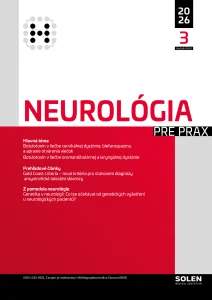


Neurológia pre prax 2/2026
Nové léčebné možnosti u hereditárních neurodegenerativních cerebelárních ataxií
doc. MUDr. Martina Bočková, Ph.D., MUDr. Tomáš Boušek, MUDr. Jaroslava Paulasová Schwabová, Ph.D., doc. MUDr. Martin Vyhnálek, Ph.D.
Přehledový článek shrnuje současné možnosti kauzální i symptomatické léčby degenerativních cerebelárních ataxií se zaměřením na dvě diagnózy, u kterých se zásadně mění každodenní neurologická praxe: Friedreichovu ataxii (FA) s nově dostupnou cílenou terapií omaveloxolonem a spinocerebelární ataxii 27B (SCA27B), u které se hromadí důkazy o účinku 4-aminopyridinu (4-AP).
Kľúčové slová: dědičné cerebelární neurodegenerativní ataxie, SCA 27B, Friedreichova ataxie, 4-aminopyridin, omaveloxolon
Novel therapeutic options in hereditary neurodegenerative cerebellar ataxias
This review summarizes current options for both disease-modifying and symptomatic treatment of degenerative cerebellar ataxias, with a particular focus on two conditions that are significantly reshaping everyday neurological practice: Friedreich’s ataxia (FA), with the recent availability of the targeted therapy omaveloxolone, and spinocerebellar ataxia type 27B (SCA27B), for which accumulating evidence supports the efficacy of 4-aminopyridine (4-AP).
Keywords: hereditary cerebellar ataxias, Friedreich’s ataxia, spinocerebellar ataxia type 27B, SCA27B, 4-aminopyridine, omaveloxolone.