



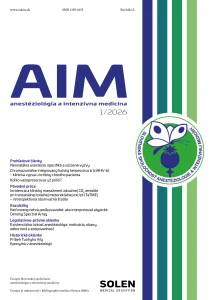
Anestéziológia a intenzívna medicína 1/2026
Keď mozog nehrá podľa pravidiel: ako interpretovať atypické Density Spectral Array
Monitorovanie hĺbky anestézie pomocou spracovaného EEG (pEEG) sa stáva v modernej anestéziológii štandardom. Rovnako ako pri každom monitore, aj výstupy na EEG monitore (indexy, DSA, surová EEG krivka) sa musia interpretovať v klinickom kontexte. Tento článok rozoberá kľúčové princípy analýzy atypických vzorcov v Density Spectral Array (DSA) a na troch kazuistikách demonštruje fenomén „beta-shift“ a jeho rozdielne príčiny.
Kľúčové slová: monitorovanie hĺbky anestézie, Density Spectral Array (DSA), fenomén „beta-shift“
When the Brain Doesn‘t Play by the Rules: How to Interpret Atypical Density Spectral Array Findings
Monitoring the depth of anesthesia using processed EEG (pEEG) is becoming standard in modern anesthesiology. As with any monitor, the outputs on the EEG monitor (indexes, DSA, raw EEG waveform) must be interpreted in a clinical context. This article discusses the key principles of analyzing atypical patterns in Density Spectral Array (DSA) and demonstrates the phenomenon of “beta-shift” and its different causes in three case reports.
Keywords: monitoring the depth of anesthesia, processed EEG, Density Spectral Array (DSA), phenomena „beta-shift“