


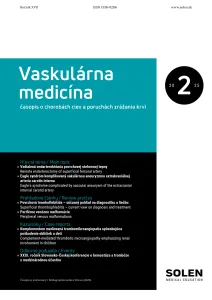
Vaskulárna medicína 2/2025
Vzdialená endarterektómia povrchovej stehennej tepny
MUDr. Peter Štefanič, PhD., DBA, doc. MUDr. Martina Zavacká, PhD., MBA, MPH
Úvod: Ischemická choroba dolných končatín spôsobená uzáverom arteria femoralis superficialis (AFS) predstavuje významnú klinickú výzvu, najmä pri uzáveroch typu C a D podľa klasifikácie TASC II. Vzdialená endarterektómia (remote endarterectomy) sa v posledných rokoch ukazuje ako perspektívna hybridná technika, ktorá kombinuje výhody otvorenej a endovaskulárnej liečby.
Cieľ: Cieľom tejto práce bolo prezentovať naše klinické skúsenosti so vzdialenou endarterektómiou AFS, zhodnotiť jej účinnosť, bezpečnosť a dlhodobé výsledky v retrospektívnej analýze pacientov liečených v rokoch 2016 – 2023. Súbor pacientov a metódy: Do štúdie bolo zaradených 42 pacientov (31 mužov, 11 žien, priemerný vek 62 rokov) s aterosklerotickým postihnutím AFS, u ktorých bola vykonaná vzdialená endarterektómia. U všetkých pacientov bola súčasne indikovaná aj endarterektómia spoločnej femorálnej artérie (AFC). V prípade potreby bola vzdialená endarterektómia doplnená o implantáciu stentu a/alebo PTA. Sledovaná bola technická úspešnosť, perioperačné komplikácie, priechodnosť rekonštrukcie a potreba ďalších intervenčných výkonov.
Výsledky: Technická úspešnosť bola 92,8 %, perioperačná mortalita bola nulová. Priechodnosť po jednom mesiaci dosiahla 97,6 % a po jednom roku 85,7 %. U piatich pacientov (11,9 %) bola do jedného roka potrebná reintervencia – u troch pacientov bola vykonaná endovaskulárna rekanalizácia, u dvoch bol indikovaný chirurgický výkon (femoro-popliteálny bypass). U jedného z týchto pacientov došlo následne k uzáveru rekonštrukcie s nutnosťou embolektómie, výsledkom však bola ireverzibilná ischémia s potrebou amputácie dolnej končatiny v stehne. Infekčné komplikácie rany neboli zaznamenané. Väčšina pacientov uvádzala klinické zlepšenie klaudikácií a vymiznutie pokojových bolestí.
Záver: Vzdialená endarterektómia predstavuje efektívnu, technicky dobre zvládnuteľnú a relatívne málo invazívnu alternatívu k femoro- -popliteálnemu bypassu u pacientov s uzávermi AFS, najmä v prípade vhodnej anatomickej situácie a zachovaného distálneho arteriálneho riečiska. Výsledky našej štúdie podporujú jej použitie ako bezpečnej a účinnej revaskularizačnej metódy pri liečbe pokročilého periférneho artériového ochorenia.
Kľúčové slová: vzdialená endarterektómia, oklúzia povrchovej stehennej artérie, hybridná revaskularizácia
Remote endarterectomy of superficial femoral artery
Introduction: Peripheral arterial disease affecting the superficial femoral artery (SFA) presents a significant clinical challenge, particularly in TASC II type C and D occlusions. In recent years, remote endarterectomy has emerged as a promising hybrid technique that combines the advantages of open and endovascular approaches. Objective: The aim of this study was to present our clinical experience with remote endarterectomy of the SFA, and to evaluate its efficacy, safety, and long-term outcomes in a retrospective analysis of patients treated between 2016 and 2023.
Patients and Methods: A total of 42 patients (31 men, 11 women; mean age 62 years) with atherosclerotic lesions of the SFA underwent remote endarterectomy. All patients also underwent common femoral artery endarterectomy. When necessary, the procedure was supplemented with stent implantation and/or percutaneous transluminal angioplasty (PTA). Technical success, perioperative complications, reconstruction patency, and the need for reintervention were evaluated.
Results: Technical success was achieved in 92,8% of cases, with no perioperative mortality. Patency at one month was 97.6%, and at one year 85.7%. Within one year, 5 patients (11.9%) required reintervention – 3 underwent successful endovascular recanalization, and 2 were indicated for surgical treatment via femoropopliteal bypass. In one of these patients, reconstruction occlusion occurred, followed by embolectomy, but irreversible ischemia developed, requiring above-knee amputation. No surgical wound infections were reported. Most patients experienced clinical improvement in claudication symptoms and resolution of rest pain.
Conclusion: Remote endarterectomy appears to be an effective, technically feasible, and relatively minimally invasive alternative to femoropopliteal bypass for patients with SFA occlusions—especially in cases with suitable anatomy and preserved distal arterial outflow. The results of our study support its use as a safe and effective revascularization method for the treatment of advanced peripheral arterial disease.
Keywords: remote endarterectomy, superficial femoral artery oclusion, hybrid revascularisation