


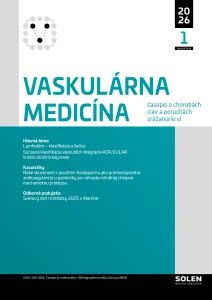
Vaskulárna medicína 1/2026
Our experience with the use of fondaparinux as bridging anticoagulation in a patient after mitral valve replacement with a mechanical prosthesis
Introduction: Determining the optimal bridging strategy for patients with mechanical valve prostheses (MVP) who must temporarily discontinue vitamin K antagonists (VKA) remains challenging, particularly when heparin use is contraindicated. We describe a case involving a patient with MVP in whom fondaparinux was employed as a bridging agent due to hypersensitivity to all available low-molecular-weight heparins (LMWHs) as well as unfractionated heparin (UFH).
Case: A 70-year-old woman with a history of mitral valve replacement with MVP, maintained on long-term VKA therapy, was admitted with symptomatic anaemia and gastrointestinal bleeding. Baseline renal parameters were in the physiological range, and the kidney functions did not change significantly throughout the hospital stay. She had documented hypersensitive reactions to both LMWHs and UFH. Owing to the necessity for multiple endoscopic interventions and the potential need for major non-cardiac surgery, fondaparinux was administered as bridging therapy at a dose of 5 mg subcutaneously twice daily, with monitoring of anti-Xa activity. The patient’s baseline body weight was 82 kilograms. Over a 23-day bridging period, no bleeding complications or thromboembolic events were observed.
Conclusion: This case demonstrates the safe and effective use of prolonged fondaparinux bridging guided by anti-Xa activity in a patient with MVP. Off-label use of fondaparinux with anti-Xa monitoring may therefore represent a viable alternative for VKA bridging in patients with MVP who are unable to receive UFH or LMWH therapy.
Keywords: fondaparinux, VKA bridging therapy, mechanical prosthetic heart valve, UFH and LMWH hypersenzitivity