

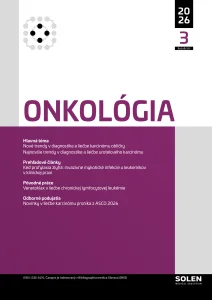
Onkológia 1/2026
Hypofractionated radiotherapy of squamous cell carcinoma of the head and neck in elderly and frail patients
Background: Squamous cell carcinoma of the head and neck (HNSCC) represents a clinical challenge in elderly and frail patients who are often unable to undergo conventional radiotherapy. Objective: To evaluate treatment outcomes in patients with squamous cell carcinoma of the head and neck (HNSCC) who were not suitable for conventional radiotherapy but met the criteria for radical hypofractionated radiotherapy.
Patients and methods: The study included patients with squamous cell carcinoma of the oral cavity, oropharynx, larynx, and hypopharynx who were frail or elderly, with an anticipated poorer tolerance to prolonged conventionally fractionated radiotherapy or chemoradiotherapy. The decision to use hypofractionated primary radiotherapy was made after multidisciplinary team evaluation. A hypofractionated radiotherapy regimen with a total dose of 55 Gy in 20 fractions over 4 weeks was used. The radiotherapy plan included either one target volume treated in 20 fractions or two volumes treated in 15 + 5 fractions. The cohort was analyzed retrospectively. Comorbidity was assessed using the Charlson Comorbidity Index (CCI), and frailty was evaluated using the Geriatric Comprehensive Screening Tool (G8). Survival analysis was performed using the Kaplan–Meier method, and comparisons were made using univariate analysis with the log-rank test. Treatment outcomes, frailty, and comorbidity prevalence were compared between two age groups: <65 years and ≥65 years.
Results: A total of 49 patients were included in the analysis. The planned radiotherapy dose was delivered with a prolongation of no more than 5 days in 89.8% of patients. Local recurrence occurred in 32.7% of patients and distant metastases in 5.8%. Thirty patients died, with HNSCC being the cause of death in 63.3%. Enteral feeding tubes were required before or during radiotherapy in 38.7% of patients, and all nasogastric tubes were removed within 1 month after completion of radiotherapy. Three-year overall survival (OS) was lower in the <65-year group compared with the ≥65-year group, with borderline statistical significance (19.0% vs. 49.9%, p = 0.069). Local control rate (LCR) and cancer-specific survival (CSS) were significantly worse in patients <65 years compared with those ≥65 years (LCR 40.8% vs. 72.7%, p = 0.013; CSS 26.5% vs. 63.9%, p = 0.005). The mean G8 score was 8.3 in patients <65 years and 10.2 in patients ≥65 years (p = 0.024), indicating a higher prevalence of frailty among younger patients in the evaluated cohort.
Conclusion: In this retrospective study, patient frailty appeared to be a more important risk factor for treatment failure than chronological age. The observed outcomes of hypofractionated radiotherapy (55 Gy in 20 fractions) suggest that this regimen is an effective and well-tolerated treatment option for elderly and frail patients with HNSCC. The short overall treatment time of 4 weeks allows this approach to be delivered to a large proportion of patients.
Keywords: head and neck squamos cell carcinoma, hypofractionated radiotherapy, frail patient, elderly oncology patients