

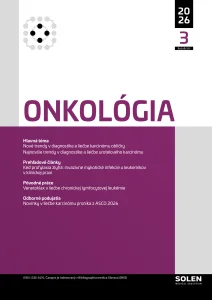

Onkológia 6/2025
Treatment of chronic lymphocytic leukemia with second-generation Bruton›s tyrosine kinase inhibitors – retrospective analysis and clinical experience
Introduction: Bruton tyrosine kinase inhibitors (BTKi) represent a key component in the treatment of chronic lymphocytic leukemia (CLL). Continuous BTKi therapy is preferred in patients with high-risk biological characteristics, particularly in the presence of TP53 deletion or mutation. Second-generation BTK inhibitors, such as acalabrutinib and zanubrutinib, are characterized by higher selectivity and improved tolerability compared to ibrutinib.
Aim: The aim of this study was to retrospectively evaluate the effectiveness and safety of acalabrutinib in treatment-naïve CLL patients in real-world clinical practice.
Patients and Methods: The analysis included 30 CLL patients treated with first-line acalabrutinib at the Clinic of Hematology and Transfusiology, Comenius University in Bratislava, between 2022 and 2025. The median age was 71 years, and 30% of patients carried TP53 aberrations. We assessed overall response rate (ORR), progression-free survival (PFS), overall survival (OS), and incidence of adverse events.
Results: We observed an overall response rate of 87% with a median time to response of 8 months. Two-year progression-free survival reached 90%, and overall survival 95%. Adverse events were mostly mild, with no severe cardiovascular complications reported.
Conclusion: Acalabrutinib proved to be an effective and well-tolerated BTK inhibitor across risk groups of CLL patients. Its efficacy and safety profile were not negatively influenced by patient comorbidities or polypharmacy.
Keywords: chronic lymphocytic leukemia, acalabrutinib, BTK inhibitors, real-world clinical practice, efficacy and safety