

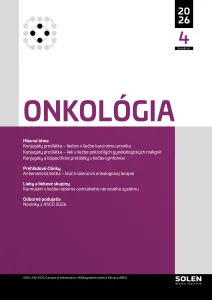

Onkológia 4/2026
Antibody-drug conjugates and bispecific T-cell engagers in the treatment of advanced lung cancer
Lung cancer remains the leading cause of cancer-related death, and therapeutic options remain limited after failure of standard treatments, including platinum-based chemotherapy, immunotherapy and targeted therapy. The limited benefit of available later-line treatment has driven the development of new modalities, including antibody–drug conjugates (ADCs) and bispecific T-cell engagers. A bispecific antibody is broadly defined by two distinct binding specificities. A bispecific T-cell engager is a functional subtype that simultaneously binds a tumour antigen and CD3 on T cells, thereby redirecting T-cell cytotoxicity against the tumour. In non-small cell lung cancer, the main targets of ADCs under development are HER2, TROP2, HER3 and c-MET; the most clinically established ADC is trastuzumab deruxtecan in HER2-mutant disease. In small cell lung cancer, the most important agents are B7-H3-directed ADCs and DLL3-directed bispecific T-cell engagers, with tarlatamab prolonging overall survival compared with second-line chemotherapy. ADCs and bispecific T-cell engagers both rely on recognition of a tumour-cell surface antigen but achieve their therapeutic effect through different mechanisms. The clinical value of these agents cannot be judged by response rate or survival alone, but also by the nature of their toxicity, its impact on quality of life and the feasibility of its management in routine clinical practice.
Keywords: lung cancer, antibody-drug conjugates, bispecific T-cell engagers, trastuzumab deruxtecan, tarlatamab, toxicity

