


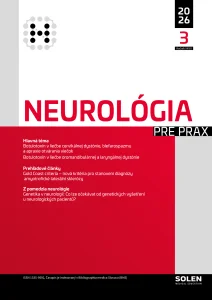






Neurológia pre prax 4/2026
The role of neurophysiology in the diagnosis of myoclonus
Myoclonus represents a heterogeneous group of hyperkinetic disorders characterized by sudden, brief muscle jerks. Precise classification according to the generator (cortical, subcortical, spinal, peripheral, or functional) is crucial for both diagnosis and treatment; however, clinical differentiation is often challenging. Diagnosis becomes even more complicated when myoclonus occurs in conjunction with another hyperkinetic disorder, for example in cervical dystonia or in typical or atypical parkinsonian syndromes. Electrophysiological methods, particularly polymyography (poly-EMG), electroencephalography (EEG), somatosensory evoked potentials (SSEP), and jerk-locked back-averaging (JLBA), enable objective assessment and accurate localization of the myoclonus generator. This article provides a practically oriented overview of the electrophysiological diagnosis of myoclonus, with a focus on interpretation of findings, technical aspects of the examinations, and an algorithmic approach applicable in neurological practice.
Keywords: myoclonus, EMG, EEG, SSEP, jerk-locked back-averaging, differential diagnosis

