

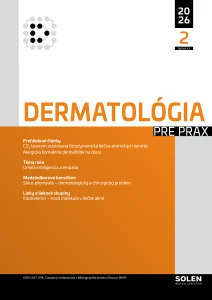
Dermatológia pre prax 3/2026
Polylactic acid and its role in corrective dermatology
Polylactic acid (PLA) is a biodegradable synthetic polymer used in corrective dermatology as a collagen biostimulator. The largest body of clinical evidence is available for poly-L-lactic acid (PLLA), while experimental and clinical evidence for poly-D,L-lactic acid (PDLLA) is expanding. PLA induces a controlled tissue response involving macrophages and fibroblasts, promoting neocollagenesis and extracellular matrix remodeling. The best-supported aesthetic indication for PLLA is correction of facial aging and volume loss. This review summarizes the mechanism of action, facial clinical efficacy, principles of application, complications, and emerging use of PLLA for facial changes associated with substantial weight loss during glucagon-like peptide-1 receptor agonist (GLP-1RA) therapy.
Keywords: polylactic acid, PLLA, PDLLA, biostimulation, neocollagenesis, corrective dermatology, GLP-1RA

