



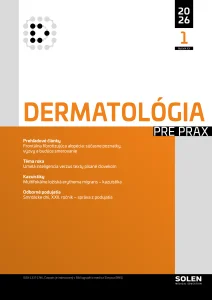

Dermatológia pre prax 1/2026
Frontal fibrosing alopecia: current knowledge, challenges, and future directions
Frontal fibrosing alopecia (FFA) currently represents one of the most common types of chronic scarring alopecia. Current knowledge of its etiopathogenesis, clinical presentation, diagnosis, and treatment options forms the basis for future research challenges and directions. This narrative study analyzes the available scientific literature published in the PubMed, Scopus, and Web of Science databases up to the year 2025, with an emphasis on peer-reviewed clinical studies, case reports, and review articles. The analysis is complemented by the author’s own clinical observations and experience. The incidence of FFA is increasing globally, particularly among postmenopausal women. However, it is also becoming more frequent in younger women and, occasionally, in men. The disease has a multifactorial etiopathogenesis involving immune, hormonal, genetic, and environmental factors. Diagnosis is based on clinical findings, trichoscopic examination, and histopathological evaluation. Treatment focuses on slowing disease progression using topical, intralesional, and systemic anti-inflammatory agents. New therapeutic approaches, including JAK inhibitors, are currently under investigation. FFA is a complex, chronically progressive disease with significant psychosocial impact. Early diagnosis and individualized treatment improve disease prognosis. Promising therapeutic outcomes have been achieved with antimalarial drugs, antiandrogen therapy, and newer immunomodulatory treatments. Future research will continue to elucidate the etiopathogenesis and support the development of targeted therapeutic strategies.
Keywords: frontal fibrosing alopecia, lichen planopilaris, scarring alopecia, environmental factors, JAK inhibitors