




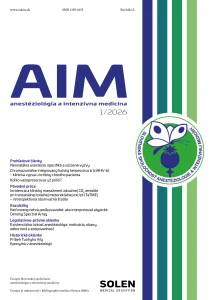

Anestéziológia a intenzívna medicína 1/2026
Neonatal anesthesia: Specific considerations and current challenges
Advances in prenatal diagnostics, perinatal care, and neonatal surgery have significantly improved the prognosis of newborns with congenital anomalies, complications of prematurity, and birth injuries. With the increasing number of surgical procedures in this age group, there is a growing need for specialized anesthetic care, which is crucial for safe perioperative management. Newborns represent a heterogeneous group of patients, ranging from extremely premature infants to term and ex-premature neonates, with specific drug responses influenced by organ immaturity and associated comorbidities. General anesthesia in neonates requires a tailored approach and cannot be considered merely an adaptation of techniques used in adults to a smaller patient. The perioperative period is associated with increased morbidity and mortality, particularly within the first 24–72 hours of life, when physiological reserves are minimal and adaptive mechanisms are insufficient. The aim of this article is to analyze the developmental physiology of the neonate and its implications for anesthetic management, with a focus on perioperative risks.
Keywords: neonatal anesthesia, neonatal physiology, anesthetic pharmacology, airway management, intraoperative monitoring