


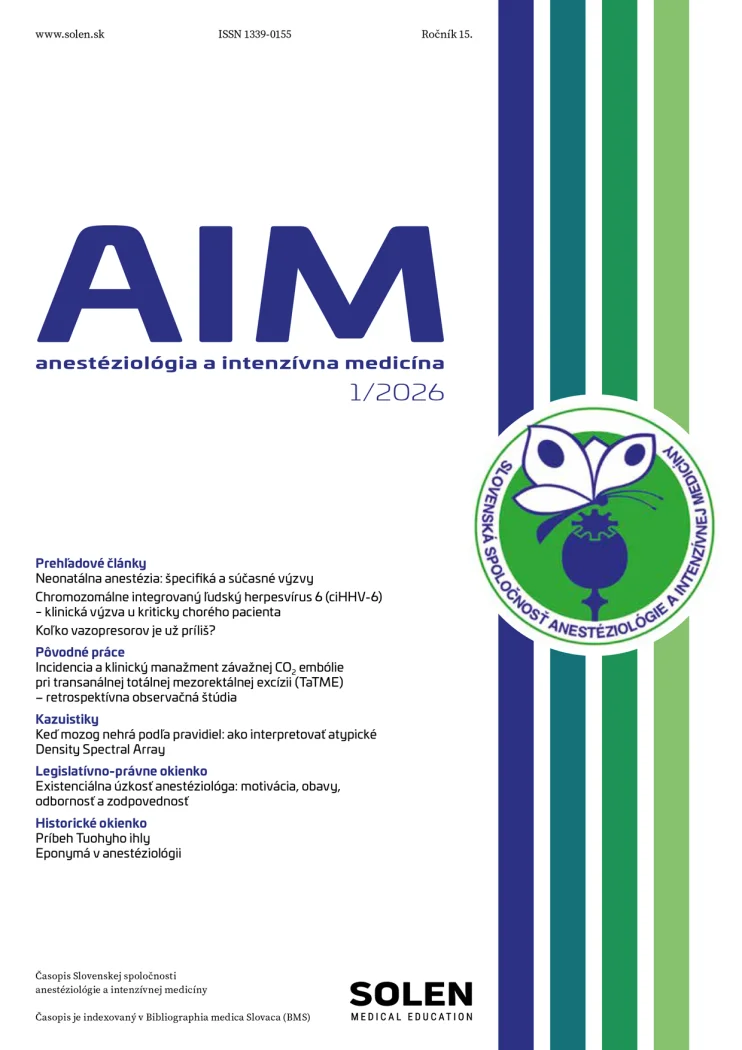
Anestéziológia a intenzívna medicína 1/2026
Incidence and clinical management of severe CO₂ embolism during transanal total mesorectal excision (TaTME) – A Retrospective observational study
Introduction: Transanal total mesorectal excision (TaTME) is a modern minimally invasive technique in the treatment of rectal cancer, which combines transabdominal and transanal approaches with CO₂ insufflation. However, it is associated with an increased risk of gas CO₂ embolism, a potentially life-threatening complication.
Objective: The aim of the study was to determine the incidence of clinically significant CO₂ embolism during TaTME, to analyze its management, clinical course and prevention options.
Material and methods: A retrospective observational study included 105 patients operated on for rectal cancer in the period 2020–2025 at the FNsP J. A. Reiman Prešov. All underwent TaTME with simultaneous transabdominal and transanal phases with CO₂ insufflation pressures in the range of 12–17 mmHg. Clinically serious CO2 embolism was considered an event with a sudden decrease in end-tidal CO₂ (etCO₂), hypotension and desaturation requiring immediate intervention.
Results: Clinically serious CO₂ embolism occurred in 4 patients (3.81%), all of whom were male. In all cases, the complication occurred during the transanal phase of the procedure. In two patients, the course was severe and required intensive treatment, while in one case there were neurological manifestations probably due to paradoxical embolism. In the other cases, prompt intervention led to rapid stabilization without permanent consequences. The most common first symptom was a sudden decrease in etCO₂, followed by hemodynamic instability and desaturation.
Conclusion: The incidence found corresponds to the upper range of values reported in the professional literature. The risk of embolism is increased especially during the transanal phase due to high insufflation pressure, anatomical conditions of the small pelvis and Trendelenburg position. Early recognition of a sudden drop in etCO₂ and prompt therapeutic intervention are crucial to reduce morbidity. Emphasis on optimizing CO2 insufflation pressures and the experience of the surgical team can significantly reduce the risk of CO2 embolism during TaTME. Limitations of the study include the retrospective design, small patient population, and lack of advanced monitoring.
Keywords: transanal total mesorectal excision, TaTME, CO₂ embolism, gas embolism, rectal cancer, laparoscopic surgery, capnoperitoneum, capnopelvis, paradoxical embolism, perioperative management