

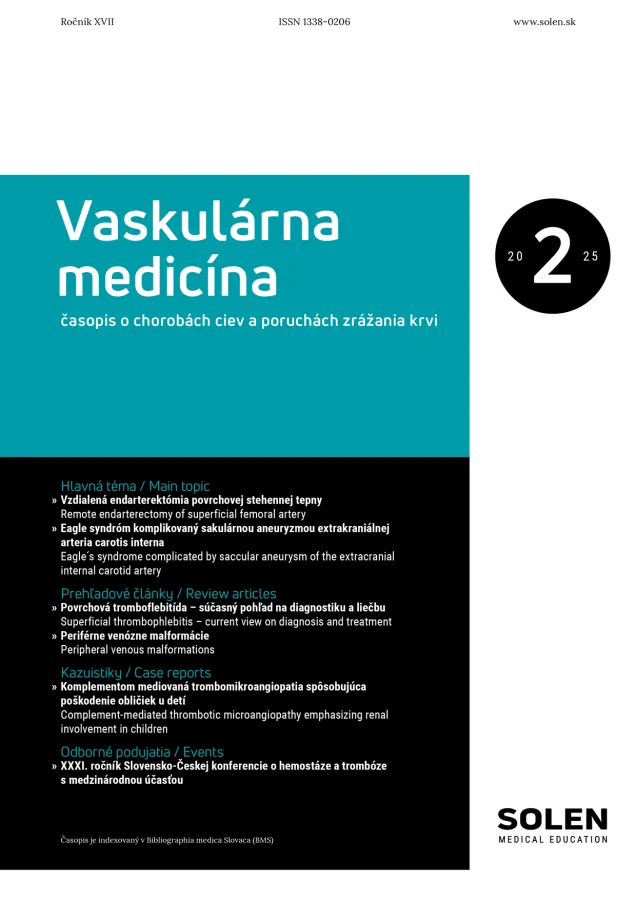
Vaskulárna medicína 2/2025
Remote endarterectomy of superficial femoral artery
Introduction: Peripheral arterial disease affecting the superficial femoral artery (SFA) presents a significant clinical challenge, particularly in TASC II type C and D occlusions. In recent years, remote endarterectomy has emerged as a promising hybrid technique that combines the advantages of open and endovascular approaches. Objective: The aim of this study was to present our clinical experience with remote endarterectomy of the SFA, and to evaluate its efficacy, safety, and long-term outcomes in a retrospective analysis of patients treated between 2016 and 2023.
Patients and Methods: A total of 42 patients (31 men, 11 women; mean age 62 years) with atherosclerotic lesions of the SFA underwent remote endarterectomy. All patients also underwent common femoral artery endarterectomy. When necessary, the procedure was supplemented with stent implantation and/or percutaneous transluminal angioplasty (PTA). Technical success, perioperative complications, reconstruction patency, and the need for reintervention were evaluated.
Results: Technical success was achieved in 92,8% of cases, with no perioperative mortality. Patency at one month was 97.6%, and at one year 85.7%. Within one year, 5 patients (11.9%) required reintervention – 3 underwent successful endovascular recanalization, and 2 were indicated for surgical treatment via femoropopliteal bypass. In one of these patients, reconstruction occlusion occurred, followed by embolectomy, but irreversible ischemia developed, requiring above-knee amputation. No surgical wound infections were reported. Most patients experienced clinical improvement in claudication symptoms and resolution of rest pain.
Conclusion: Remote endarterectomy appears to be an effective, technically feasible, and relatively minimally invasive alternative to femoropopliteal bypass for patients with SFA occlusions—especially in cases with suitable anatomy and preserved distal arterial outflow. The results of our study support its use as a safe and effective revascularization method for the treatment of advanced peripheral arterial disease.
Keywords: remote endarterectomy, superficial femoral artery oclusion, hybrid revascularisation