


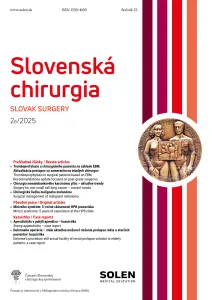
Slovenská chirurgia 2-3/2017
The role and importance of measuring fibrinolytic agents uPA and PAI-1 in oncosurgical patients
The process of tumor cells spreading is not caused solely by their uncontrolled proliferation. The tumor cell is detached and migrates from its origin, degrades extracellular matrix components, invades the endothelium of the blood and lymphatic vessels, and then settles in remote locations. Tumor-directed tissue remodeling involves neovascularisation, desmoplasia (stimulated proliferation of fibroblasts) and deposition of the extracellular matrix in the vicinity of the tumor. Fibrinolytic system consisting of serine proteases plasmin and urokinase plasminogen activator (uPA), serpin inhibitors alpha-2-antiplasmine, plasminogen activator inhibitors 1 and 2 (PAI-1, PAI-2), and uPA receptor (uPAR), plays a causative role in degradation of basal membrane and extracellular matrix as well as new vessel formation. Negative predictive value of elevated uPA and PAI-1 was proved in several types of malignancies. In patients with early breast cancer with negative lymph nodes, high levels of uPA and PAI-1 in tumor tissue show stronger prognostic value compared to conventional tumor markers, and their determination is officially recommended for the identification of a high-risk group of patients benefiting from adjuvant systemic therapy. Recently, many authors have been discussing the importance of uPA and PAI-1 in various tumor types, moreover several synthetic fibrinolytic inhibitors are already involved in clinical trials as possible future treatment agents.