


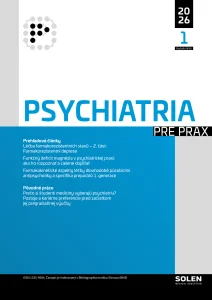



Psychiatria pre prax 4/2025
Dopamine D3 receptors as a bridge to integrated treatment of dual diagnoses in real-world clinical practice in Slovakia
Dual diagnosis (schizophrenia with comorbid substance use disorder) is associated with higher clinical burden, poorer adherence and relapse vulnerability. Dopamine D3 receptors represent a plausible bridge between negative symptoms and reward-motivation pathways relevant to addiction. We summarize the neurobiological rationale and emerging clinical evidence for the D3-preferring partial agonist (cariprazine) in dual disorders. The practical part is based on a post-hoc analysis of dual-schizophrenia patients identified within a 12-month prospective observational cohort (N = 188). Changes in CGI-S, m-SAND, SNS, PSP and treatment patterns were assessed. Twenty-two patients met criteria for dual schizophrenia. Illness severity (CGI-S) improved from 5.0 to 3.4, and negative symptoms decreased significantly (SNS −11 points; m-SAND −11.4 points; p < 0.0001). Overall PSP remained broadly stable with improvement in selected domains. Antipsychotic burden decreased (mean number of concomitant antipsychotics 2.3 → 1.5), and a proportion of patients transitioned to cariprazine monotherapy. Qualitative clinical information suggested a favorable trend in substance use outcomes. Cariprazine may be a useful pharmacological component of an integrated treatment plan for dual schizophrenia, particularly when negative symptoms dominate. Larger prospective studies with standardized SUD outcomes (craving, abstinence days, biomarkers) and functional endpoints are warranted.
Keywords: dual diagnosis, schizophrenia, substance use disorder, dopamine D3 receptor, cariprazine